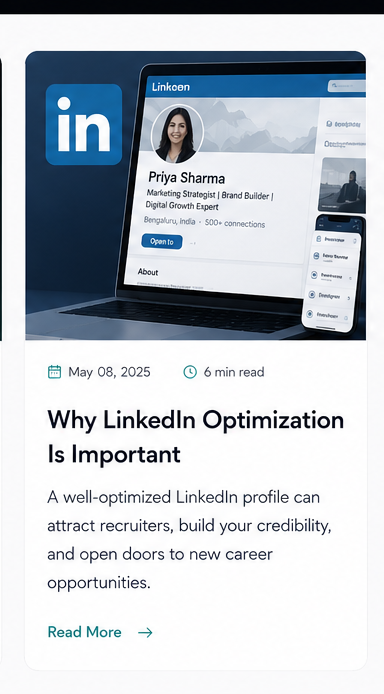
Recruiters don't read a LinkedIn profile top to bottom the first time — they skim. Research from LinkedIn's own recruiter tools suggests a profile gets somewhere between 6 and 15 seconds before a decision to look closer, or move on. In that window, three things carry almost all the weight: your headline, your photo and banner, and the opening lines of your About section. Everything else supports the decision once you've already earned a closer look.
1. Your headline is doing more work than your job title
By default, LinkedIn fills your headline with your current job title and employer. That's a missed opportunity — it tells a recruiter where you work, not what you're good at or where you're headed.
Instead of: "Marketing Executive at ABC Ltd"
Try: "Marketing Strategist | Driving Growth Through Data-Led Campaigns for D2C Brands"
This also matters for search — recruiters filter LinkedIn using keywords, and your headline is one of the most heavily weighted fields. Include the terms someone would search for your target role.
2. Photo and banner set the tone before anyone reads a word
- Use a recent, well-lit headshot with a plain or softly blurred background — profiles with a photo get significantly more views and connection requests than those without.
- Dress for the role you want, not necessarily the one you have.
- Replace the default banner with something that reinforces your field or personal brand — even a simple, clean graphic beats a blank grey background.
3. Structure your About section as a hook, not a biography
Most About sections read like a resume paragraph. A stronger structure treats the first 2–3 lines as the hook — the only part visible before "see more" — and builds from there.
- Opening hook: who you are and the outcome you're known for, in one confident sentence.
- What you do: your core skill set and the kind of problems you solve.
- Proof: one or two concrete results, with numbers where possible.
- Direction: what you're looking for next, so the right opportunities find you.
- A simple call to action — how someone should reach out.
4. Make your Experience section recruiter-searchable
Just like a resume, LinkedIn's search surfaces profiles based on keyword match. Write Experience bullets the same achievement-led way — action, what you did, measurable result — and repeat your core skills naturally across roles instead of only listing them once in the Skills section.
5. Keep your resume and LinkedIn telling the same story
Recruiters frequently cross-check both. Inconsistent titles, dates or achievements between your resume and profile raise doubts even when the underlying experience is genuine. Your headline, About and top experience bullets should reinforce — not duplicate word-for-word, but align with — your resume's positioning.
Quick LinkedIn Checklist
- Headline states role, specialization and value — not just job title
- Professional photo and a banner that reflects your field
- About opens with a strong hook in the first two lines
- Experience bullets are achievement-led and keyword-rich
- Top skills match your target role and are reflected in your bullets
- Story is consistent with your resume
A LinkedIn profile isn't a copy of your resume — it's a recruiter-facing front door. Getting the first few seconds right is what earns you the rest of their attention.